Showing posts with label books. Show all posts

Saturday, February 25, 2012

Atonement: The writer's point of view

In the novel Atonement by Ian McEwan the main character is Briony, who at age 13 is a budding author. She already thinks like a writer most of the time, seeing plots for novels and stories in the family life and nature surrounding her. The world to her is a place of inspiration for something she can later put down in writing. In a way her life is lived more on the page than in her direct contact with the surrounding world.

The whole book is circling around the theme of writing, the word as expression, or even the word as a more real reality than reality. I think this is something many bookworms can recognise, readers and writers alike - the world of fiction and literature is the preferred place to hang out. More safe and controlled perhaps, but also a place where there is room for high ideals and strong, fatelike friendships, fantastic actions and heart-wrenching sacrifices in the name of love, humanity, truth etc. Of course literature is mirroring to some extent the world the authors live in, but still - a different place to reality.

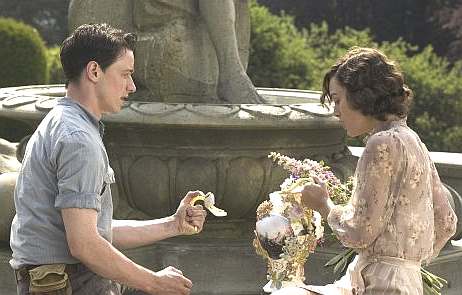
A favourite moment of mine in this novel is Briony's literary culmination when she has had an awakening and is being hurled out of childhood, all through seeing a scene in the park surrounding her house, involving her sister Cecilia and the family friend Robbie. This scene is the structural hub of the novel. Briony is too young and misinterprets what she sees - a feud between two near adults who have known each other their whole lives and who are beginning to understand that they love each other. Briony sees them argue over a broken vase in front of the fountain on the lawn, and interprets the whole situation wrongly. She sees Robbie threatening Cecilia (he is actually trying to stop her from stepping on the broken bits of the vase) and is convinced she has to protect her sister from this man. Her suspicion is later galvanised when Robbie uses Briony as a messenger in bringing Cecilia a letter. The letter was supposed to be an apology for his behaviour around Cecilia lately, with him hinting at his new feelings towards her. But of course McEwan has him putting the wrong note into the envelope, one including a word Briony has never heard before but immediately understands as belonging to the just-discovered world of grown-up dealings; and of course he has Briony, the writer who needs to know everything about the world around her, reading it. ("The smooth-hollowed, partly enclosed forms of its first three letters were as clear as a set of anatomical drawings.") The scene and the word is spiralling her into a different existence.

Anyway, a passage I've always loved in this novel, culminating in a single sentence, is where Briony is writing down her opening line of a story after seeing the fountain scene and understanding that she must enter a new level of writing and existing; enter the grown-up world and write about more serious layers of reality than fairytale princesses and storylines always ending in good marriages.

She sits in front of the white paper, pen in hand, and after considering everything she has seen and started to understand that day, writes "There was an old lady who swallowed a fly".

This one sentence, seemingly a leap from the context she is consumed in, to me says a lot about what writing is. From one kind of material springs a whole new material or world, somehow related to its origins, but often very different in form and content (if 'origins' is a word possible to use around the writing process). Creativity doesn't move in orderly autobahn-lines, it makes the most surprising leaps, leading us to completely new places with strange and fresh connections to the world we know and the evergrowing literary geography.

Not magic, only the endless possibilities of human imagination.


Sunday, June 19, 2011

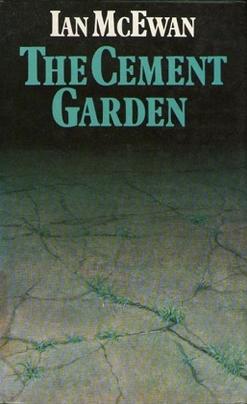
Ian McEwan - The Cement Garden

Recently I read another book of Ian McEwan's; The Cement Garden. It has one of those openings that makes me tear the book out of its shelf and read on, hoping to see the first sentences' microcosm confirmed and developed throughout the story.

The opening, simple as it is:
"I did not kill my father, but I sometimes felt I had helped him on his way. And but for the fact that it coincided with a landmark in my own physical growth, his death seemed insignificant compared with what followed."
Those words were enough for me to pursue the rest of the sentences, tying together a whole which is a lot more than its parts. In literature this gestalt-like idea of a whole being more than its parts (namely, words and sentences) is quite obvious. A novel, a poem, and a play and so on, needs a human to decode, put together and create the piece anew. Or maybe not completely anew, but to see the 3D image beyond the words, the natural thing for any reader to do. The mystery of the reading process -- or part of it, at least. And then every one of us creates a slightly different world out of the same words on the pages, giving several thousand different stories and milieus out of the one. Depending on the number of the readers, of course.  

What signifies McEwan's style? Economy, rhythm, precision and a faint unnerviness, like there's something about to go wrong, which also happens in many of his books. And from this; a poetry of prose, so to speak. This novel is no exception, as the intro hints at in its effective way. Despite, and at the same time because of, this feeling of looming doom, I dashed through the pages, but giving myself enough time to notice the wry, crisp, seemingly innocent style the story is delivered in. The contrast between the content and the way it is told is quite titillating, and I found myself reading through passages quite sinister without the more expected reaction of horror or even condemnation but with a sense of observing something rather everyday and normal. That level of persuasiveness from a narrator is simply impossible not to enjoy.

Even so, there is a build-up of an underlying horror throughout the story that has to be released somehow. If the story hadn't made this happen (in a way), it probably would have seeped out into my own personal sphere of life in some fashion. Either through a certain kind of tension, or a feeling of unease, or a sort of creative space where the contradictions piled up to some kind of release in one medium or other. Which I guess it did, anyway, as I felt I had to write about the book here, and discuss it with others.

Also the language itself, simple but convincing, prosaic yet poetic, lit up its own area in my field of consciousness -- not only the part of language love or aesthetic pleasure, but some deep receptive place underlying aesthetic praise. Which is where most aesthetic experiences come from, anyway. But maybe you get what I mean.

Looking for images for the book's cover to put on this blog I realized there's actually been made a film out of this book, in 1993. It also seems to be his first novel after a couple of short story collections. That this is a debut novel would make my jaw drop with awe, had I not found this expression too silly. But figuratively, jaw down.

Thursday, May 12, 2011

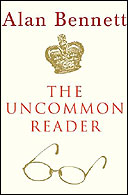
The Uncommon Reader by Alan Bennett

What a long stretch of time it has been since I last sat down in front of this blog. Busy-bee has been the state of me for the last few months. Actually this will continue till mid-June, but I found I couldn't stay away any longer.

There hasn't really been time for much quality reading; quality reading demanding, exactly, time - and most importantly: a mind bent on the idea of sitting down for some time with nothing other than yourself and another's voice. 

It was actually at Easter that I decided I should make some time for just sitting down without any other intent than listening (that is; reading). The last day before the Easter holidays I went to the library and borrowed three books from the local library's thinly populated shelf of English novels. (I was then staying at a temporary flat awaiting our new flat to be fully renovated and refurbished. Our present library luckily holds a large portion of literature in English.)

The book that gave me the most out of the three I borrowed was Alan Bennett's The Uncommon Reader. I already knew about the book as it's been translated into Norwegian, but I hadn't read it and intuited that it would be perfect for a couple of sunny hours at the balcony. And so it was.

I didn't expect a book full of dry wit, understatement and an ever growing list of authors to check in with, but that is what I got. Quite the surprise. 

The uncommon reader happens to be the Queen of England herself, Elizabeth II. This book portrays the activity of reading and what might follow from it. When a personage like the Queen takes up reading, it has rather a large impact on her life and how she lives it. She simply discovers the world of reading -- the vast, fantastic, gory, dark, rich and sometimes frustrating world of reading. How many of these authors she has met already, through some gathering at the Palace, without the slightest idea who she has been sitting next to or lead such a boring, conventional conversation with. The regrets she has! The opening scene is priceless, where the president of France is taken completely by surprise by the Queen's new range of conversation topics:
'Now that I have you to myself,' said the Queen, smiling to left and right as they glided through the glittering throng, 'I've been longing to ask you about the writer Jean Genet.' 
'Ah,' said the president. 'Oui.' 
The Marseillase and the national anthem made for a pause in the proceedings, but when they had taken their seats Her Majesty turned to the president and resumed.
'Homosexual and jailbird, was he nevertheless as bad as he was painted? Or, more to the point' - and she took up her soup spoon - 'was he as good?' 
Unbriefed on the subject of the glabrous playwright and novelist, the president looked wildly about for his minister of culture. But she was being addressed by the Archbishop of Canterbury.
'Jean Genet,' said the Queen again, helpfully. 'Vous le conaissez?'
'Bien sûr,' said the president.
'Il m'intéresse,' said the Queen.
'Vraiment?' The president put down his spoon. It was going to be a long evening.

The whole book follows in this dry and witty but somehow warm and passionate style, portraying the Queen as an interesting and interested being, as she is on a kind of quest of luring out what literature is all about and what writers have been thinking and, of course, writing for several hundred years. Leading to some quite dramatic change, I can tell you.

In fact, Bennett's fictitious Queen made me feel rather more sympathetic to the real one, in itself a way of thematising literature's strange powers. Imagining oneself into the head and life of someone, famous or not, can have quite the effect on the reader and the way she views the person described. In this case it opened me to the possible quirky and humorous sides to the English monarch - the more human sides to the very polished facade, I dear say.

Bennett has written a lot of plays, and this is quite visible in his dialogues: oral, to the point and often with a humorous edge. This and the whole bibliophile theme going on made me melt completely to this book.

I guess this is what you can call a recommendation.

Happy spring to you!   

Thursday, February 11, 2010

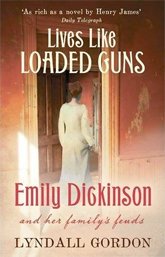
Lyndall Gordon on Emily Dickinson

I just bought this book at Norli in Oslo, Norway, and I can't wait to read it. Lyndall Gordon, the author, is also the author of a well-documented biography on T. S. Eliot which I found interesting and balanced.

Earlier I have read the biography by Richard Sewall, which I can recommend. His book treated Dickinson's whole life, while this one seems to focus on her past few years, and the way her family's different intrigues affected not only her remaining years, but also the handing down of the myth of her life. One of Gordon's theses is that the family's feuds disturbed and restructured Emily Dickinson's legacy. Without a quarreling and intriguing family, whose members wanted to be the ones to administer and own the 'truth' about Emily Dickinson, there might not be such a mystery enveloping this poet today.

I probably wouldn't have bought this book if it hadn't been for the author. Many books on Emily Dickinson are treating rather obscure issues only, it seems, to earn some money on her famous name. And, of course, because so many books have been written about her already. This book might be one of those, but I hope that Gordon, who amongst other things is a senior research fellow at St Hilda's College, Oxford, is able again to balance a lot of information and possible rumours that might make this kind of book into a (better selling) pile of (more or less) baseless slander.

Anyway, can't wait to read it. It is always rewarding to read another person's take on poems you have read many times yourself. And, of course, the person behind the poems is set in a much bigger context than you yourself would be able to dig up if you were to read dissertations and history books and link everything together on your own. A book like this holds more interest to me than many novels. A book filled with citations of some of all time's most introspective, strange, innovative and ethereally beautiful poems and probably some background information of their issues and themes - how much more interesting can it get?

Update February 13th: I came across this article in the Guardian today, written by Lyndall Gordon herself. It seems that she is professing a theory about Dickinson quite similar to something I have thought myself for a long time: that the poet wasn't a shy and fragile recluse, but rather a passionate, inventive and decided person following her own tune. She did, as we know, write about "A still volcano life" in one of her poems, seemingly a good description of the kind of existence I imagine she had. Perhaps she decided that the only way a woman like her could live out her passion to write and be free, was to withdraw from society and its rather constricting rules of how to live and what to do.

"Uncomprimising", Gordon calls her. Seems like a good one-word summary of this intense and brilliant creature. And this sentence I love: "This woman was not like us: to know her is to encounter aspects of a nature more developed than our own."

Yes indeed.
Another update
: As I'm reading this book it turns out that it is actually a biography of Emily's whole life, but with her more as a part of the Dickinsonian circumference, the family's affairs, doings and dynamics etc. Which I think is a really good idea to portray the person in the poet in a fuller way.

Thursday, January 28, 2010

Ian McEwan - Atonement

To anyone who has searched around this blog a bit, you may have noticed my fondness for Ian McEwan in general and the novel Atonement especially. I just ended my fourth read of this novel a few days ago, and to me it just keeps getting better. Probably for as long as I shall live, this will be one of my favourite books.

When I ask myself why, there is no one bright and shiny answer to this, but many small slightly shimmering ones which do, I believe, flow from the same mysterious something, like a well of things coming together and creating a whole which is bigger than its consistent parts. And this something seeps through the whole of this story. The way it is told, what is being told, the characters of the story who are carrying the tale forward. All refined and believably real -- and then real in a good way. All are interesting characters with personified traits. I have really started to like the ordinariness of Cecilia, for example. There is great power in ordinariness as long as one fills it and leaves it be, without trying to become something much more than what one actually is. In Cecilia's case, it turns out she is strong-willed with a pure mind, something which in combination with her ordinariness makes a solid character. And Robbie is of course a guy with which I would very much like to be acquainted -- filled with a kind of vitality and initiative and a self-made sharpness which is something to reach for in one's own life.
And then there is Briony, the eye and mind of the whole story, the narrator and the closer and the genesis of the narrative in this form.

The whole novel is in a way about writing, of genre, style and the nature of narrating. It is about how good stories have an intelligence of their own, and how when mixed with real lives, horrible things might happen. The language captures all of this completely. McEwan's endless sensibility in the land of words, rhythms, sounds and associations leads you through this painful and beautiful, dreamlike and starkly realistic story. Some of the beauty is the mixture of the flowing of the words and the characters' thoughts on the one hand, and on the other the brutality of the events spiralling out from the central point of the plot: Briony's lie, spun around a scene of two lovers which this thirteen year old girl cannot understand. It is her imagined version of reality which is setting the frame for this story and which makes the tragedy happen.
There is a whole line of the discussion of this novel which can be spun around the role of the author in modern society, the place and/or danger of a vivid imagination etc. and these are interesting thoughts. I just don't have room for them in this posting.
And then, of course, there is the beautiful tragic love story at the centre of the plot. I find it impossible to keep my eyes dry when watching the movie (by Joe Wright). Two lovers undeservedly ripped apart and the lifelong atonement of the storyteller gets me every time. I try to cling to the fact that it is all fictional, but that doesn't do any good of course (and what is the difference between reality and fiction when it comes to how and what really moves us?). Again I realize that there is nothing like a strong love story to have me coming back to a story over and over. I mean, why else would I read Pride and Prejudice so many times? And although Atonement doesn't actually end happily, I am still drawn towards this book. The beauty of the language, the aliveness of the characters, the poetry of frame, actions and history seeping through every word. To me the story even has a scent, a watery, pure, fresh and sweet scent. (Did Wagner ever include smells in his idea of the Gesamtkunstwerk?)
In a way I believe that it is the story which attracts the author, the story which comes to the author and starts unwinding itself in the author's sensory field. Of course it takes a fine mind to give the story flesh and colour, sound and breath the way McEwan does it but it is still my belief that many of the best stories have presented themselves in some way (and artists seem to be people who are more sensitive to this) and that it is down to the writer to try to uncover and convey it the best way possible.
Here is an excerpt of McEwan's next novel Solar, taken from The New Yorker, a weekly magazine. No need to say that I am looking forward to this one.

Tuesday, December 29, 2009

Literary and real-life struggles

It's been a long time since a piece of literature has moved me like Norwegian author Karl Ove Knausgård's ongoing six volume epic Min kamp (My Struggle) about his own life does me now. Through reading the first three volumes (only the three are out yet), the level of reflection over my own childhood is what has most notably been boosted. His detailed memories, which cannot be distinguished from his fictionally empowered vague or incomplete recollections, are in themselves quite striking, but what has been really freeing for me is the way he looks straight at his own earlier life, not filtering or trying to escape the shame and embarrassment which often follows in the wake of childhood memories. He is looking directly, unsentimentally and quite painfully at his own childhood, warts and all (literally so). Embarrassing moments, every fear he has had, every shortcoming and every blunder; all is portrayed and layed out for the reader to see.

From this description, Knausgård's project may sound like social pornography, or like a man seeking complete attention for who he is down to his most petty flaw, but I can't see it like that. For one, this author is rather withdrawn, not even wishing to do interviews when his books are published, or even really caring about appearing for collecting awards (although he does do all these things). Secondly, this six-volume work is really good literature. I don't know any better way of describing his writing than as being really good literature. His writing is epic, novelistic, essayistic, confessionalistic, but all in a mix that is quite uniquely Knausgårdian and carrying the mark of high quality. This is a novel whose content is played out on wide screen rather than on a normal screen, that's what it is. Far more detailed, plunging, playful, broadly scoped and painfully more honest than most well-written literature. It's even silver screen writing for what I know.

So, where does all this leave me? Amongst all the moments of elated reading and painful recognition, I am left in a state of influence. His way of fearlessly taking in who he is and used to be, is nothing less than inspiring and somewhat paradigm-changing to me. This is something which rarely happens, but all the more enjoyable when it actually does: that something I read enters my own life or personal space for real. Turning mental pictures and ideas into reality. That's what good art does to me.

Friday, October 16, 2009

Sebastian Faulks' Engleby and Mozart in words


Currently I am reading the novel Engleby by Sebastian Faulks and I enjoy it greatly. I picked it up in a library of the old sort - the kind you have in old manor houses. Amongst various philosophical books and other kinds of nonfiction, this gem was hiding. Once again, Vintage shows a real knack for good covers. This cool, yet somewhat mystic cover certainly made me interested.

BUT this was supposed to be a small post about a funny passage I read in this novel. The story is told in first person, and the first sentence (a theme not uninteresting), goes like this: "My name is Mike Engleby, and I'm in my second year at an ancient university." The following sentence nuances what kind of narrator we're dealing with: "My college was founded in 1662, which means it's viewed here as modern." Short and to the point, but with a chilly, detached and sarcastic undertone. The style is sophisticated, smart and slightly unnerving.
This narrator called Mike Engleby has a distanced view of the world and seems after a while to go from critical and laconic to half-mad and on the outside looking in. He comments his surroundings and his own history with a somewhat disinterested voice, even when what he reports is rather disturbing. It is as if he is on a stabilizer drug, not allowing either emotional highs or lows (and slowly as the novel unfolds you begin to suspect he is not completely trustworthy - he certainly does his share of illegal drugs, and the turn of the story with a disappeared girl he seems obsessed with, makes you think that you're being presented with a very limited version of the truth).
But what first struck me about this novel was the compelling, smart, witty, intelligent voice that opened up and led me through the story. As an outsider to the British ancient university and educational system, this seemed to me an interesting peephole into that honourably stoneclad and dusty space. The narrator is obviously bright, having started in English literature before he transferred to Natural sciences. This kind of witty, inventive and knowing narrator's voice seems almost absent from the Norwegian literary scene. More of that, please!
SO what about this funny passage? It is really quite simple and short, but it made me laugh out loud while reading it on my flight from London to Oslo earlier this week. He simply portrays the way Mozart turns his musical motives:
I can't see the point in Mozart. Of Mozart I can't see the point. The point
of Mozart I can't see. See I can't of Mozart the point. Can't I of Mozart point
the see... I can't see the point of Mozart.
That's not a tune, it's an algorithm. An algorithm in a powdered wig.
See what I mean about witty and compelling? I have to smile again, reading it a second time.
Perhaps I shall write a followup to this post when I have read the whole book - it is always a danger to describe a book when you haven't read the whole thing. But I think I am beginning to understand the plot here, and things are not looking good for poor dear wacky Engleby.

Tuesday, September 22, 2009

First sentences

There is a Norwegian author named Karl Ove Knausgård who has embarked on a literary project somewhat similar to that of Proust's. In six volumes, counting 2500 pages, he writes about the whole of his life from childhood to today - though he is no more than forty. The style isn't quite as enveloped and enveloping as Proust's (a good thing, surely, as this work is actually a hundred years) and, funnily enough, far more prosaic. At least on the surface.

Only the first volume has been published, but two more will follow before christmas; one in October, one in November. The last three probably in January, February and March. (If anyone is cunning in Germanic languages, they will notice a concordance with the title on the picture to the right to the work of an infamous

Austrian some 70 years ago. An edge the author obviously wanted to his already quite noticeable endeavour. He is certainly not afraid to be called pretentious, and has also called this project a "literary suicide". As this theme demands a whole post of its own, I am continuing on a different note.)
I'll have to admit at once that I have not yet read this latest book of Knausgård's, but I am probably going to as I have read all (two!) previous books of his. Just the first page. But often you can get a sense of the whole work just by reading one page.
Like Proust, Knausgård introduces his hexalogy with a sentence easy to remember: "For hjertet er livet enkelt: det slår så lenge det kan." Or in English, something like this: "For the heart life is simple: it beats as long as it can" (pretty direct translation, no work of an expert). In Norwegian this sentence has a rhythmical drive, a simplicity in sounds and words, yet at the same time a poetic edge made out of words as basic as stick and straw, water and stone. What follows in this opening paragraph is a detailed, physical description of human death. Detailed, but still with that literary voice trailing behind, leading the prosaic (though dramatic) course to its end.
Proust's opening sentence is one of the most famous in the history of literature: "Longtemps, je me suis couché de bonne heure" - or "For a long time, I went to bed early." As we know, Proust has forever linked his name to the little dry bisquit called madelaine. I remember listening to a radio programme sometime around my twelfth year, hearing a woman speak passionately about an author who wrote in these marvellous sentences which stretched over two pages, and how he could describe the taste of a cake through pages and pages - and I remember really longing to find out how this literature was. Sadly the lady in my radio never mentioned the author's name from the time I got to listen to her, but I feel quite sure that it must have been Proust she was going on about. The joy of being presented with this strange and unknown literary master was almost greater than that of years later finding out who this person was, and later still to read some of his prose.

This simple yet alluring opening sentence reminds me of what often pulls me into a book: a taste of the author's very own universe, with the novel's specific tone included. Isn't this the reason we read books? To be enveloped in a strange but somehow familiar world where time is most relative and you are in a strange position between being the master of deciding the world's progress (as you decide when to pick up the book an break it off) as well as being led by the hand through a story you have no control over. "The world moves in appetency on its metalled ways", Eliot would have put it ("Burnt Norton" III).

A good example of first sentences which also says a great deal about the rest of the book is the beginning of Jane Austen's Emma: "Emma Woodhouse, handsome, clever, and rich, with a comfortable home and happy disposition, seemed to unite some of the best blessings of existence; and had lived nearly twenty-one years in the world with very little to distress or vex her." In this rather long sentence, we are introduced to the main character and the story which will unroll almost directly from her characteristics. This is a character-driven story with Emma in the thick of every twist and turn of the intrigues; she is actually the embodiment of the plot.
I love the idea of opening a book on any given page and getting the flavour, or almost the whole idea, of a book. And this flavour is probably strongest on the first page, where the author holographically presents his project to you, the reader. One can become incredibly wealthy feasting on brilliant minds. So subsequently, which place to go expand your mind-wallet beats the library?

Sunday, October 12, 2008

Poetic Playfulness


I would like to launch a theory: A large part of a poet’s or writer's significance may lay in his or her playfulness, her ability to play with language and meaning and creating out of it a sensible whole with surprising turns of sense and imagination.

With this I do not mean playfulness in and of itself as in puns and annoying alliteration (haha), but as part of a larger oevre, with this as another layer of showing a perceptive mind and an ability to use language in a new and original way. Humour shows another meta-layer of language perceptibility or sensibility, and when sense is filtered through a layer of playfulness, this usually adds life to the written work in question.

It is always liberating to see a writer play with his or her own universe, to insert a streak of light heartedness or humour in his/her work. It actually shows a sense of love for language and a sort of return to the reasons he or she became a writer in the first place. Why write, why not paint or play an instrument or act or create in a different way? Language is the writer’s instrument, and through it he depicts every little nuance of what he feels like mediating. Language is also the most diverse and differentiated means of communication we have, which leaves writers with a great and thrilling responsability. Without creative souls reinventing language every day, it would stay static, and professional writers do have an impact on how we perceive reality and our own way with words. I, for one, am happy about this. Thoroughly thought through ways of using language always upgrade the system.

Especially with T. S. Eliot playfulness is a welcome feature. His poems often seem difficult and zig-zawed together from citations and allusions to other literary works. But he has another, more creative side as well, and this is eloquently and enjoyably expressed in his poems in Old Possum’s Book of Practical Cats, a work which is quite extraordinarily different from his other works and was meant for children. Here he is inventive and playful and produces a completely different tone from his more austere works like The Waste Land, Ash-Wednesday and most of his plays.

In many ways, writing for children seems to open a vein of creativity in authors. For example, it was not until J. K. Rowling started writing a children’s book that she got published, and why do we love Tolkien’s works so much? Or C. S. Lewis’s books about Narnia? Alice in Wonderland? Fairytales? In them fantasy, imagination and creativity is in free flow! It is a beautiful part of human existence to be able to create new worlds in which many other people feel at home and loved.

Thank heaven for the imaginative writers!

Monday, September 29, 2008

What is literature for

I'd like to cite an American author who just died but of whom I have never read a word. I came across an obituary in Morgenbladet, one of the few decent Norwegian papers. Central to this periodical is politics, societal issues and quite as important: cultural issues, with a range of book reviews and literary discussions.

Anyway, the citation is from the late David Foster Wallace, and immediately hit a chord with me:

The task of literature is to "disturb the comfortable and comfort the disturbed".

A simple as that. In many ways I agree with this sententia - it certainly covers central sectors of why literature is such a vitally important part of human society. Reading is important in order to challenge your own world view, and to expand both your horizon and vocabulary. The expanding of vocabulary also has the side-effect of clearing and adding depth and discriminative powers to your mind, something not quite unheard of. Through literature you enter completely different spheres than your own bubble of reality, and in many ways this is a means of gathering experience from fields you would never come in contact with in other arenas. You can sharpen your mind in the meeting of other minds, who through literature has found their own particular style - yet another benefit of a novel, short story, essay etc. A piece of literary art is (usually) a thought-through, carefully composed world of its own and in many ways one of the finest gifts a human can give another human being. "This is my world and you're welcome to enter it" seems a good caption to follow every book.
Quite as important as stirring up the far too comfortable sphere of consensus that most people more or less live in, is the other dimension of Wallace's words: To comfort those who find life hard and difficult and feel outside the rest of humanity. This is also a place many of us will find ourselves from time to time and it can be a great comfort as well as a reality check to read about other people's experiences and thoughts and through this find ourselves to be part of a whole even though we didn't believe it to begin with. We can even find soulmates in authors we have never met and will never meet - this, to me, is one of the greatest gifts literature can offer.
Literature is of course also an outstanding (probably the best) method for conservation of the thoughts and ideas of old masters.
I guess much of what is written in this post comes as nothing new, but it is still nice to remind ourselves sometmes why we read. And of course there are many more reasons for reading than what I have listed here. Want to add some?


Wednesday, July 30, 2008

Birthday of Emily Brontë (1818-1848)


I remember Wuthering Heights as one of the best and most passionate love novels I have ever read, but looking back carefully I actually don't think I ever finished it. Although I remember a lot of the novel's action, it had a deeper emotional impact than an intellectual one. Recounting this piece of literature, it is the feeling of despair and impossible love, a contraction around the heart and a sea of sadness in the chest that is present with me. And this hints at why I never finished the story - I simply didn't stand the anguish and turmoil. Being quite an emotional reader (some times, at least) the story's innumerable difficulties were simply too much.
A little biographical information:


It's the birthday of the novelist Emily Brontë, born in Thornton, England, in 1818. Emily Brontë, who wrote what is considered one of the greatest love stories of all time, Wuthering Heights (1847), but who never had a lover and almost never talked to anyone besides her family and her servants. She and her sisters Anne and Charlotte and their brother, Branwell, educated themselves at home, reading their father's large collection of classic literature, while their father locked himself up in his room and even ate dinner alone. Emily was interested in mysticism, and she had no friends. Emily also wrote poetry. Her sister Charlotte discovered some of her verses: "I looked it over, and something more than surprise seized me, —a deep conviction that these were not common effusions, not at all like the poetry women generally write. I thought them condensed and terse, vigorous and genuine. To my ear, they had also a peculiar music—wild, melancholy, and elevating." In 1848, Emily died of tuberculosis when she was just 30 years old, standing in the living room of her family's parsonage with one hand on the mantle. Emily Brontë wrote in Wuthering Heights:

"I cannot express it; but surely you and everybody have a notion that there is, or should be, an existence of yours beyond you. What were the use of creation, if I were entirely contained here?"

And,
"I have dreamed in my life, dreams that have stayed with me ever after, and changed my ideas; they have gone through and through me, like wine through water, and altered the colour of my mind."
I think this last sentence, of dreams permeating one's mind with a watery colour resembling that of wine through water, is exquisite. What a sensual, tactile, even tasty impression it makes! It really is tactility, vision, taste and smell in one image. Remarkable as well as eye and mouth-watering.

Saturday, July 05, 2008

Is the time for the long reads over?


Today I was thinking:
Is the time for concentration over?

Is the time for longtime commitment to thorough reading a forgotten art?

Are "slow texts" and literature that demand more from you than 30 minutes a day, perhaps even spread out between text messages, phone calls and checking your mail losing the battle in these efficient times? I really sensed a voice telling me that I couldn't possibly consider sitting down a couple of hours every day to do what I enjoy so much: read.
Walking past a shelf in a book store today with a display of Proust's In Search of Lost Time or Remembrence of Things Past, a memory of reading the first volume of his long mémoire filled me -- or rather, my memory of reading his wonderfully rich text brought back the feeling of how it was to read him. It actually feels like a deep, fluid-like presence in the whole of my chest, particularly in the heart-area.
But this sweet, thick fluid was immediately mixed with a mild melancholy, as I felt how rarely I get to sink into the wonderland of makebelieve and literature that I inhabited as a child, when this kind of excess was allowed.
Proust's texts are a mix of makebelieve and real life, and offers a texture so rich, so deeply reverberating in your soul (at least in mine) that it's strange how seldom I actually find the time to dive into them and similarly magical literary landscapes.
Naturally, when our macrostructure tends towards fragmentation and speedy efficiency without time for depth and continuous study, the small structures suffer the same destiny. You are such a microstructure which is part of the macro; in fact you are the ones making the macro, and that means you can also change this structure from within.
Want the world to allow you to spend a few hours a day with continued, unabrupted concentration? Just do it! Spend those hours by yourself. You will help make this place better to live in.

Friday, June 20, 2008

Beedle the Bard and I


Today I'd like to post the text I entered for the Beedle the Bard-competition held by Amazon UK and US. The winner of this competition would be awarded a trip to London, stay in a hotel, and most important of all - be allowed a reading of Ms Rowling's unpublished book of handwritten stories (which only exists in 7 copies), namely The Tales of Beedle the Bard. As I would be thrilled by this experience, I naturally entered the contest.

There were three tasks you could choose among, writing in a "creative" way. (This adjective annoys me a little; what writing is not creative?) You were only allowed one entrance, and that entrance should not consist of more than 100 words. Which is not a lot. Of course, judging by the 10 finalists in each of the two age groups (13-18 and 18 and above), every smartass understood this as writing in verse, that is to say, old fashioned, rhyming poetry. To me, poetry can exist everywhere, not only in rhythmical, pulse-driven verse. Although you get to say a lot in a few words with the tried and tested ballad-style.

Nevertheless. The three options you had were:
  • What songs do wizards use to celebrate birthdays?
  • What other sports do wizards play besides Quidditch?
  • What have you learned from the Harry Potter series that you use in everyday life?

- and I chose the first, as the theme of music and magic struck me as the most poetical of the three. (Of course, the winner wrote a versified answer to the least poetical of the three, namely the last one. And it really was quite good, also she was under 18, which is a good thing in this kind of competition.)

So, tata, here is my response to what songs wizard sing to celebrate their birthdays:


When each wizard is born a colour surrounds them, and in this colour there is a sound. Every birthday allows the colour of their soul to seep out for a while, bringing with it a new sound. In this way a song starts to form. When a wizard's birthday is celebrated, their family and friends gather and listen to the new song performed by the wizard himself and sing it back to him. In the end of his life the song envelops the wizard as a deeply coloured fabric. Purple is only worn by wizards with especially beautiful soul songs.

© Tuva Langjord 2008

Tuesday, June 17, 2008

A sucker for covers


I may be strange, but I have always really enjoyed this cover for T.S. Eliot's collected poems. On the screen you can only see the graphics and the colouring (all good), but in real, tactile life you can touch the simplicity, elegance and smoothness of the book. The cover is made in some kind of smooth carton which is just luxuriously simple and supple beneath your fingers.


It is the honourable house of Faber&Faber that publishes Eliot's work. Eliot himself worked there for several years, providing him with a much needed steady income. Poets and playwrites never did get a lot of money for their hard work.
Have a great, summery Tuesday
(Here it is rather windswept, but sunny all the same)
Love from me and