Friday, May 21, 2010

"Thirteen ways of looking at a blackbird" by Wallace Stevens

For many weeks now a sole blackbird has been singing outside our window, morning and evenings. Sitting in one of the large trees it keeps unfolding its neverending and everchanging repertoire of variations over the present.

The colour black was never more fitting than on the hue of this bird. The deep peace the blackness promises keeps flowing from its orangish beak, and the rich silky texture of a deep and quiet layer of existence unrolls itself from its tones. They give me the sense of liquid black.

Wallace Stevens gives a series of haiku-like interpretation of the blackbird in this poem.

You don't know where the blackbird ends and silence begins.


THIRTEEN WAYS OF LOOKING AT A BLACKBIRD

I
Among twenty snowy mountains,
The only moving thing
Was the eye of the blackbird.

II
I was of three minds,
Like a tree
In which there are three blackbirds.

III
The blackbird whirled in the autumn winds.
It was a small part of the pantomime.

IV
A man and a woman
Are one.
A man and a woman and a blackbird
Are one.

V
I do not know which to prefer,
The beauty of inflections
Or the beauty of innuendoes,
The blackbird whistling
Or just after.

VI
Icicles filled the long window
With barbaric glass.
The shadow of the blackbird
Crossed it, to and fro.
The mood
Traced in the shadow
An indecipherable cause.

VII
O thin men of Haddam,
Why do you imagine golden birds?
Do you not see how the blackbird
Walks around the feet
Of the women about you?

VIII
I know noble accents
And lucid, inescapable rhythms;
But I know, too,
That the blackbird is involved
In what I know.

IX
When the blackbird flew out of sight,
It marked the edge
Of one of many circles.

X
At the sight of blackbirds
Flying in a green light,
Even the bawds of euphony
Would cry out sharply.

XI
He rode over Connecticut
In a glass coach.
Once, a fear pierced him,
In that he mistook
The shadow of his equipage
For blackbirds.

XII
The river is moving.
The blackbird must be flying.

XIII
It was evening all afternoon.
It was snowing
And it was going to snow.
The blackbird sat
In the cedar-limbs

***

This poem was published in Stevens' first collection of poetry, Harmonium - from which "The Wind Shifts" also comes.

Like the blackbird, Wallace Stevens is circulating the stillness and emptiness ("When the blackbird flew out of sight, / It marked the edge / of one of many circles" is one example). The whole tone of this poem seems to me that of simplicity emerging from a deep spring, just like the blackbird's song does.

And then there is the mysteriousness of the unwordable sensations the black and the blackbird evokes in us: "The river is moving. / The blackbird must be flying." This I can very well understand, but can I explain it? It's like that other poem of his, "The Plain Sense of Things" -  "The great pond, / the plain sense of it, without reflections, leaves, / Mud, water like dirty glass, expressing silence/ of a sort". How do you explain the plain sense of things? You don't, you sense it and know it directly. In the same way existence plays itself out. 

Poetry and other kinds of art keep circling the circumference of something much more mysterious and deep than we tend to know, in this way hinting at a vast unspoken dimension. Wallace Stevens' take on the blackbird does this so beautifully and obviously that I probably don't need to write another line about it.


Friday, May 07, 2010

Wallace Stevens: The Wind Shifts

This poem by American poet and lawyer Wallace Stevens was published in 1923, when Stevens was 44 years old. The collection is called Harmonium and was, as far as I know, Stevens' first published collection of poetry.

His poems often have a refined tone, almost as if they are a little out of reach, like slightly unapproachable people who just seem to be a bit better than you in everything, without you really understanding how and why. This poem has a somewhat lighter or more simple tone than many of the poems I have read by him, but a simple surface tends to be quite traitorous.


THE WIND SHIFTS

This is how the wind shifts:
Like the thoughts of an old human,
Who still thinks eagerly
And despairingly.
The wind shifts like this:
Like a human without illusions,
Who still feels irrational things within her.
The wind shifts like this:
Like humans approaching proudly,
Like humans approaching angrily.
This is how the wind shifts:
Like a human, heavy and heavy,
Who does not care.

***


To me, this poem indicates that great responsibility is laid on our shoulders, that unclarity and unmetabolised thoughts and beliefs are quite as dangerous as more material or physical troubles. What we think and how we act do make an impact, and perhaps more than we normally think. Not only do we impact our surroundings, but also what one could call the human space - our shared sphere of ideas and movement of beliefs and values, really the overall level of consciousness which we create and sustain.

I think it is the general movement throughout this poem which speaks most directly to me. There is a windswept feeling as if someone is unsettling the balance of the finely tuned fugue of Being, gushes of air which are perhaps necessary in order to notice what one made unbalanced in the first place. There really is the sense of a great human breath here, a sense that all our mistakes, disruptions and disturbances of the global environment (spiritually as well as physically) are necessary and simply part of the way the human species is unfolding.

Naturally this reading is quite influenced from the climatic challenges we are now facing, but the sense of responsability and the invisible ways in which our thoughts and murky inner waters influence our space is quite striking to me in this poem. I think I'll explore Wallace Stevens' poetry more. It seems I can choose a random page of his collected poetry and find something of depth and refinement there. How much more recommendation do I need?

Wednesday, March 31, 2010

From Little Gidding, fourth of the Four Quartets by T.S. Eliot

This is an excerpt whose rhythm and contents have been ringing through me for a few hours now, so I figured I should take a look at it again to see how it really goes. It is from Eliot's Four Quartets, and I've always loved this passage in the fourth and last quartet's second part (called Little Gidding, the name of a place in England which Eliot had visited in 1936, prior to writing the three remaining quartets. The first, "Burnt Norton", was written in 1935, at first meant to be a single poem, but was followed by three related quartets in 1939-43.).

Like almost every other part of the Quartets, this section offers new layers of insight nearly every time I read it - if thoroughly done.


In the uncertain hour before the morning
      Near the ending of interminable night
      At the recurrent end of the unending
After the dark dove with the flickering tongue
      Had passed below the horizon of his homing
      While the dead leaves still rattled on like tin
Over the asphalt where no other sound was
      Between three districts whence the smoke arose
      I met one walking, loitering and hurried
As if blown towards me like the metal leaves
      Before the urban dawn wind unresisting.
      And as I fixed upon the down-turned face
That pointed scrutiny with which we challenge
      The first-met stranger in the waning dusk
      I caught the sudden look of some dead master
Whom I had known, forgotten, half recalled
      Both one and many; in the brown baked features
      The eyes of a familiar compound ghost
Both intimate and unidentifiable.
      So I assumed a double part, and cried
      And heard another's voice cry: 'What! are you here?'
Although we were not. I was still the same,
      Knowing myself yet being someone other—
      And he a face still forming; yet the words sufficed
To compel the recognition they preceded.
      And so, compliant to the common wind,
      Too strange to each other for misunderstanding,
In concord at this intersection time
      Of meeting nowhere, no before and after,
      We trod the pavement in a dead patrol.
I said: 'The wonder that I feel is easy,
      Yet ease is cause of wonder. Therefore speak:
      I may not comprehend, may not remember.'
And he: 'I am not eager to rehearse
      My thoughts and theory which you have forgotten.
      These things have served their purpose: let them be.
So with your own, and pray they be forgiven
      By others, as I pray you to forgive
      Both bad and good. Last season's fruit is eaten
And the fullfed beast shall kick the empty pail.
      For last year's words belong to last year's language
      And next year's words await another voice.
But, as the passage now presents no hindrance
      To the spirit unappeased and peregrine
      Between two worlds become much like each other,
So I find words I never thought to speak
      In streets I never thought I should revisit
      When I left my body on a distant shore.
Since our concern was speech, and speech impelled us
      To purify the dialect of the tribe
      And urge the mind to aftersight and foresight,
Let me disclose the gifts reserved for age
      To set a crown upon your lifetime's effort.
      First, the cold friction of expiring sense
Without enchantment, offering no promise
      But bitter tastelessness of shadow fruit
      As body and soul begin to fall asunder.
Second, the conscious impotence of rage
      At human folly, and the laceration
      Of laughter at what ceases to amuse.
And last, the rending pain of re-enactment
      Of all that you have done, and been; the shame
      Of motives late revealed, and the awareness
Of things ill done and done to others' harm
      Which once you took for exercise of virtue.
      Then fools' approval stings, and honour stains.
From wrong to wrong the exasperated spirit
      Proceeds, unless restored by that refining fire
      Where you must move in measure, like a dancer.'
The day was breaking. In the disfigured street
      He left me, with a kind of valediction,
      And faded on the blowing of the horn.

***

This is an hommage to Dante, whose style Eliot here wished to imitate. He found it very hard, he said, but I find this section lyrical, flowing, musical and with a rather mystical atmosphere placed as it is between midnight and dawn and with its metal leaves rattling like tin over the empty streets. I guess you can spot a few similarities to La Divina Commedia. One, as already mentioned, is the terza rima style which Dante used in his most central work. Another is how the lyrical 'I' meets a person who seems to be guiding him through this transitional place, like Dante's I meets Virgil. It could also be suggested that it is Dante himself the I meets - although this is a rather far stretch, I agree.

Another literary echo seems to be Hamlet, or rather the ghost of Hamlet's father in the beginning of the play. He, too, appears after sundown and fades at the breaking of the day. And the whole setting is equally mysterious - even spooky.

Still it is a piece of poetry closely linked to Eliot's everyday "routine" during the beginning of the war. He used to be part of a fire guard, walking the streets of London at night looking for fires caused by German planes ("the dark dove with the flickering tongue").

Anyway, the piece has value on its own as well as part of a large tradition and Eliot's personal circumstances. The best thing is of course to read the whole of the work, the four quartets together, for a better insight into this surprisingly manifold piece of literature. A good thing is also to listen to it, if you have access to a recording of the Quartets. Then you will really get it under your skin, rhythm and music especially. Which would probably please Eliot, who esteemed the music of language and actively sought to give his poetry that aesthetic quality.

Enough quartet and Eliot-speak for now? Think so.

Sunday, March 28, 2010

Form and emptiness

By Taikkun Yang Li at http://taikkun.com/
As the Sunday settles I'd like to highlight a quote from Dalai Lama on form and emptiness, a closely knit pair:

"Since form (phenomena) is emptiness and emptiness is form, then instead of a hand grasping at nothing, it is better to grasp at someone´s nose because this is closer to reality." How can anyone not be fond of this man?

And so, the subject matter. Empty and non-empty are two impossible ways of describing, in lack of a better word, emptiness. Form/phenomena and emptiness are viewed to be two sides of a coin, two ways of describing the same thing. One cannot, it seems, describe and name the things that surpass language, that lie beyond the scope of conceptualization. How, then, can one grasp this notion?

One is through paradox. By embracing paradoxical truths, sitting with them, walking with them, bending one's mind to them. 'Can I contain this? How does this make sense? What part of my being is touched by this?' And then to quiet one's mind to linguistic intrusion. Language is not the place to get what lies in the form/emptiness thought. Toss any pair of concept overboard, and concentrate on the direct knowing of reality: "At the still point of the turning world [...] there the dance is" (T.S. Eliot). Or

Not dependent on another, peaceful and
Not fabricated by mental fabrication,
Not thought, without distinctions,
That is the character of reality (that-ness). (Nagarjuna, Mulamadhyamakakarika, XVIII, 9. Transl. J. Garfield.)

At the same time: words are needed in order to get our thoughts out there, and of course to learn what other people are thinking. There's obviously a necessity to travel from a non-verbal state as an infant, into the world of concept and language and then to take a few steps (or more) into the wordless, timeless sphere. "Only through time time is conquered" (my friend Eliot again).
In this wilderness of concepts and words and what one really means by the words one speaks, Dalai Lama seems to have a wonderfully pragmatic and playful approach to it all - at least when he is speaking to us laymen. He seems to emanate a wonderful and easy lightheartedness, a true kind of contentment. To me, only a look at his face makes my heart lighten up. And forget about any tight knot of ideas and language and fuzzy thinking. Life can be so light!

Friday, March 19, 2010

The Name of a Fish by Faith Shearin

Don't you just love this title? And the smooth summery cool it brings along. As well as a quiet blue hope for tomorrow. I didn't know I was looking for this poem before I found it.


The Name of a Fish

If winter is a house then summer is a window
in the bedroom of that house. Sorrow is a river
behind the house and happiness is the name

of a fish who swims downstream. The unborn child
who plays in the fragrant garden is named Mavis:
her red hair is made of future and her sleek feet

are wet with dreams. The cat who naps
in the bedroom has his paws in the sun of summer
and his tail in the moonlight of change. You and I

spend years walking up and down the dusty stairs
of the house. Sometimes we stand in the bedroom
and the cat walks towards us like a message.

Sometimes we pick dandelions from the garden
and watch the white heads blow open
in our hands. We are learning to fish in the river

of sorrow; we are undressing for a swim.


by Faith Shearin
from "The Owl Question", 2002

***


How well caught the image of the cat walking "towards us like a message". The silent dignity of their charachter transferred to you in a flash.
Then there is an underpinning of water throughout the poem, making it flowing, cool and hydrating while at the same time it is carrying a soothing and reassuring note - and just a hint of melancholy.

Then again, it is the whole of the poem rather than its parts which makes the impression, wouldn't you say?

Thursday, February 11, 2010

Lyndall Gordon on Emily Dickinson

I just bought this book at Norli in Oslo, Norway, and I can't wait to read it. Lyndall Gordon, the author, is also the author of a well-documented biography on T. S. Eliot which I found interesting and balanced.

Earlier I have read the biography by Richard Sewall, which I can recommend. His book treated Dickinson's whole life, while this one seems to focus on her past few years, and the way her family's different intrigues affected not only her remaining years, but also the handing down of the myth of her life. One of Gordon's theses is that the family's feuds disturbed and restructured Emily Dickinson's legacy. Without a quarreling and intriguing family, whose members wanted to be the ones to administer and own the 'truth' about Emily Dickinson, there might not be such a mystery enveloping this poet today.

I probably wouldn't have bought this book if it hadn't been for the author. Many books on Emily Dickinson are treating rather obscure issues only, it seems, to earn some money on her famous name. And, of course, because so many books have been written about her already. This book might be one of those, but I hope that Gordon, who amongst other things is a senior research fellow at St Hilda's College, Oxford, is able again to balance a lot of information and possible rumours that might make this kind of book into a (better selling) pile of (more or less) baseless slander.

Anyway, can't wait to read it. It is always rewarding to read another person's take on poems you have read many times yourself. And, of course, the person behind the poems is set in a much bigger context than you yourself would be able to dig up if you were to read dissertations and history books and link everything together on your own. A book like this holds more interest to me than many novels. A book filled with citations of some of all time's most introspective, strange, innovative and ethereally beautiful poems and probably some background information of their issues and themes - how much more interesting can it get?

Update February 13th: I came across this article in the Guardian today, written by Lyndall Gordon herself. It seems that she is professing a theory about Dickinson quite similar to something I have thought myself for a long time: that the poet wasn't a shy and fragile recluse, but rather a passionate, inventive and decided person following her own tune. She did, as we know, write about "A still volcano life" in one of her poems, seemingly a good description of the kind of existence I imagine she had. Perhaps she decided that the only way a woman like her could live out her passion to write and be free, was to withdraw from society and its rather constricting rules of how to live and what to do.

"Uncomprimising", Gordon calls her. Seems like a good one-word summary of this intense and brilliant creature. And this sentence I love: "This woman was not like us: to know her is to encounter aspects of a nature more developed than our own."

Yes indeed.
Another update
: As I'm reading this book it turns out that it is actually a biography of Emily's whole life, but with her more as a part of the Dickinsonian circumference, the family's affairs, doings and dynamics etc. Which I think is a really good idea to portray the person in the poet in a fuller way.

Thursday, January 28, 2010

Ian McEwan - Atonement

To anyone who has searched around this blog a bit, you may have noticed my fondness for Ian McEwan in general and the novel Atonement especially. I just ended my fourth read of this novel a few days ago, and to me it just keeps getting better. Probably for as long as I shall live, this will be one of my favourite books.

When I ask myself why, there is no one bright and shiny answer to this, but many small slightly shimmering ones which do, I believe, flow from the same mysterious something, like a well of things coming together and creating a whole which is bigger than its consistent parts. And this something seeps through the whole of this story. The way it is told, what is being told, the characters of the story who are carrying the tale forward. All refined and believably real -- and then real in a good way. All are interesting characters with personified traits. I have really started to like the ordinariness of Cecilia, for example. There is great power in ordinariness as long as one fills it and leaves it be, without trying to become something much more than what one actually is. In Cecilia's case, it turns out she is strong-willed with a pure mind, something which in combination with her ordinariness makes a solid character. And Robbie is of course a guy with which I would very much like to be acquainted -- filled with a kind of vitality and initiative and a self-made sharpness which is something to reach for in one's own life.
And then there is Briony, the eye and mind of the whole story, the narrator and the closer and the genesis of the narrative in this form.

The whole novel is in a way about writing, of genre, style and the nature of narrating. It is about how good stories have an intelligence of their own, and how when mixed with real lives, horrible things might happen. The language captures all of this completely. McEwan's endless sensibility in the land of words, rhythms, sounds and associations leads you through this painful and beautiful, dreamlike and starkly realistic story. Some of the beauty is the mixture of the flowing of the words and the characters' thoughts on the one hand, and on the other the brutality of the events spiralling out from the central point of the plot: Briony's lie, spun around a scene of two lovers which this thirteen year old girl cannot understand. It is her imagined version of reality which is setting the frame for this story and which makes the tragedy happen.
There is a whole line of the discussion of this novel which can be spun around the role of the author in modern society, the place and/or danger of a vivid imagination etc. and these are interesting thoughts. I just don't have room for them in this posting.
And then, of course, there is the beautiful tragic love story at the centre of the plot. I find it impossible to keep my eyes dry when watching the movie (by Joe Wright). Two lovers undeservedly ripped apart and the lifelong atonement of the storyteller gets me every time. I try to cling to the fact that it is all fictional, but that doesn't do any good of course (and what is the difference between reality and fiction when it comes to how and what really moves us?). Again I realize that there is nothing like a strong love story to have me coming back to a story over and over. I mean, why else would I read Pride and Prejudice so many times? And although Atonement doesn't actually end happily, I am still drawn towards this book. The beauty of the language, the aliveness of the characters, the poetry of frame, actions and history seeping through every word. To me the story even has a scent, a watery, pure, fresh and sweet scent. (Did Wagner ever include smells in his idea of the Gesamtkunstwerk?)
In a way I believe that it is the story which attracts the author, the story which comes to the author and starts unwinding itself in the author's sensory field. Of course it takes a fine mind to give the story flesh and colour, sound and breath the way McEwan does it but it is still my belief that many of the best stories have presented themselves in some way (and artists seem to be people who are more sensitive to this) and that it is down to the writer to try to uncover and convey it the best way possible.
Here is an excerpt of McEwan's next novel Solar, taken from The New Yorker, a weekly magazine. No need to say that I am looking forward to this one.

Tuesday, December 29, 2009

Literary and real-life struggles

It's been a long time since a piece of literature has moved me like Norwegian author Karl Ove Knausgård's ongoing six volume epic Min kamp (My Struggle) about his own life does me now. Through reading the first three volumes (only the three are out yet), the level of reflection over my own childhood is what has most notably been boosted. His detailed memories, which cannot be distinguished from his fictionally empowered vague or incomplete recollections, are in themselves quite striking, but what has been really freeing for me is the way he looks straight at his own earlier life, not filtering or trying to escape the shame and embarrassment which often follows in the wake of childhood memories. He is looking directly, unsentimentally and quite painfully at his own childhood, warts and all (literally so). Embarrassing moments, every fear he has had, every shortcoming and every blunder; all is portrayed and layed out for the reader to see.

From this description, Knausgård's project may sound like social pornography, or like a man seeking complete attention for who he is down to his most petty flaw, but I can't see it like that. For one, this author is rather withdrawn, not even wishing to do interviews when his books are published, or even really caring about appearing for collecting awards (although he does do all these things). Secondly, this six-volume work is really good literature. I don't know any better way of describing his writing than as being really good literature. His writing is epic, novelistic, essayistic, confessionalistic, but all in a mix that is quite uniquely Knausgårdian and carrying the mark of high quality. This is a novel whose content is played out on wide screen rather than on a normal screen, that's what it is. Far more detailed, plunging, playful, broadly scoped and painfully more honest than most well-written literature. It's even silver screen writing for what I know.

So, where does all this leave me? Amongst all the moments of elated reading and painful recognition, I am left in a state of influence. His way of fearlessly taking in who he is and used to be, is nothing less than inspiring and somewhat paradigm-changing to me. This is something which rarely happens, but all the more enjoyable when it actually does: that something I read enters my own life or personal space for real. Turning mental pictures and ideas into reality. That's what good art does to me.

Sunday, November 22, 2009

Brautigan's Scarlatti Tilt


How about a short short story?


I know Hemingway is said to have claimed that his best short story went like this: "For sale: baby shoes, never worn." While this seems to be a more or less truthful anecdote, this kind of strikingly short way of expression has spawned a movement of six word stories and other kinds of flash fiction. In Norway, a book called "Du trenger ikke mer enn 6" ("You don't need more than 6") has been published - no doubt inspired by the Hemingway-anecdote.

This really isn't my area of expertise, but I immediately thought of a short short story by Richard Brautigan, brilliantly named "The Scarlatti Tilt":

"'It's very hard to live in a studio apartment in San Jose with a man who's learning to play the violin.' That's what she told the police when she handed them the empty revolver."


And that's it!
It's perhaps not too difficult to write stories in a fragmental way which the reader has to put together to a kind of meaningful web, but more interesting, I find, to write short short stories with a point or plot. These kinds of stories share the structure with the riddle or joke, but are still something different.
A short short post on a long long Sunday.

Monday, November 02, 2009

e.e.cummings: i carry your heart with me


I just had to put out this poem by e.e.cummings. For a few days, the opening lines have pounded through me -- not like a mantra -- but with its very own, strong rhythm. What strikes me so, I think, is a combination of an almost naïve serenading of the I's beloved and the amount of courage it takes to stitch such simple, open words to the world's most terrifying experience: that of being in love. And then to publish the poem in all its straightforwardness - stout heart, mr. cummings-bard!

The imagery of the poem is clear and almost concretely solid, with its sun and moon, fate, soul and tree of life. Almost like the illustrations of a childrens's book.

"I carry your heart with me I carry it in my heart" - such simple but strangely strong words. The repetitiveness and the insistence on the word heart beats through the whole poem and contributes to the archetypal imagery which makes up this poem's stem, its own tree of life.
The last sentence (before the first sentence is repeated) is liberatingly expansive. The sun and air and immense black space of existence always gushes in through my chest when I read this. That the power of our own care and love is the strength which keeps the stars apart - what a freeing thought.


i carry your heart with me(i carry it in
my heart)i am never without it(anywhere
i go you go, my dear;and whatever is done
by only me is your doing,my darling)
i fear
no fate(for you are my fate,my sweet)i want
no world(for beautiful you are my world,my true)
and it's you are whatever a moon has always meant
and whatever a sun will always sing is you

here is the deepest secret nobody knows
(here is the root of the root and the bud of the bud
and the sky of the sky of a tree called life;which grows
higher than soul can hope or mind can hide)
and this is the wonder that's keeping the stars apart

i carry your heart with me(i carry it in my heart)
**

Friday, October 16, 2009

Sebastian Faulks' Engleby and Mozart in words


Currently I am reading the novel Engleby by Sebastian Faulks and I enjoy it greatly. I picked it up in a library of the old sort - the kind you have in old manor houses. Amongst various philosophical books and other kinds of nonfiction, this gem was hiding. Once again, Vintage shows a real knack for good covers. This cool, yet somewhat mystic cover certainly made me interested.

BUT this was supposed to be a small post about a funny passage I read in this novel. The story is told in first person, and the first sentence (a theme not uninteresting), goes like this: "My name is Mike Engleby, and I'm in my second year at an ancient university." The following sentence nuances what kind of narrator we're dealing with: "My college was founded in 1662, which means it's viewed here as modern." Short and to the point, but with a chilly, detached and sarcastic undertone. The style is sophisticated, smart and slightly unnerving.
This narrator called Mike Engleby has a distanced view of the world and seems after a while to go from critical and laconic to half-mad and on the outside looking in. He comments his surroundings and his own history with a somewhat disinterested voice, even when what he reports is rather disturbing. It is as if he is on a stabilizer drug, not allowing either emotional highs or lows (and slowly as the novel unfolds you begin to suspect he is not completely trustworthy - he certainly does his share of illegal drugs, and the turn of the story with a disappeared girl he seems obsessed with, makes you think that you're being presented with a very limited version of the truth).
But what first struck me about this novel was the compelling, smart, witty, intelligent voice that opened up and led me through the story. As an outsider to the British ancient university and educational system, this seemed to me an interesting peephole into that honourably stoneclad and dusty space. The narrator is obviously bright, having started in English literature before he transferred to Natural sciences. This kind of witty, inventive and knowing narrator's voice seems almost absent from the Norwegian literary scene. More of that, please!
SO what about this funny passage? It is really quite simple and short, but it made me laugh out loud while reading it on my flight from London to Oslo earlier this week. He simply portrays the way Mozart turns his musical motives:
I can't see the point in Mozart. Of Mozart I can't see the point. The point
of Mozart I can't see. See I can't of Mozart the point. Can't I of Mozart point
the see... I can't see the point of Mozart.
That's not a tune, it's an algorithm. An algorithm in a powdered wig.
See what I mean about witty and compelling? I have to smile again, reading it a second time.
Perhaps I shall write a followup to this post when I have read the whole book - it is always a danger to describe a book when you haven't read the whole thing. But I think I am beginning to understand the plot here, and things are not looking good for poor dear wacky Engleby.

Tuesday, September 22, 2009

First sentences

There is a Norwegian author named Karl Ove Knausgård who has embarked on a literary project somewhat similar to that of Proust's. In six volumes, counting 2500 pages, he writes about the whole of his life from childhood to today - though he is no more than forty. The style isn't quite as enveloped and enveloping as Proust's (a good thing, surely, as this work is actually a hundred years) and, funnily enough, far more prosaic. At least on the surface.

Only the first volume has been published, but two more will follow before christmas; one in October, one in November. The last three probably in January, February and March. (If anyone is cunning in Germanic languages, they will notice a concordance with the title on the picture to the right to the work of an infamous

Austrian some 70 years ago. An edge the author obviously wanted to his already quite noticeable endeavour. He is certainly not afraid to be called pretentious, and has also called this project a "literary suicide". As this theme demands a whole post of its own, I am continuing on a different note.)
I'll have to admit at once that I have not yet read this latest book of Knausgård's, but I am probably going to as I have read all (two!) previous books of his. Just the first page. But often you can get a sense of the whole work just by reading one page.
Like Proust, Knausgård introduces his hexalogy with a sentence easy to remember: "For hjertet er livet enkelt: det slår så lenge det kan." Or in English, something like this: "For the heart life is simple: it beats as long as it can" (pretty direct translation, no work of an expert). In Norwegian this sentence has a rhythmical drive, a simplicity in sounds and words, yet at the same time a poetic edge made out of words as basic as stick and straw, water and stone. What follows in this opening paragraph is a detailed, physical description of human death. Detailed, but still with that literary voice trailing behind, leading the prosaic (though dramatic) course to its end.
Proust's opening sentence is one of the most famous in the history of literature: "Longtemps, je me suis couché de bonne heure" - or "For a long time, I went to bed early." As we know, Proust has forever linked his name to the little dry bisquit called madelaine. I remember listening to a radio programme sometime around my twelfth year, hearing a woman speak passionately about an author who wrote in these marvellous sentences which stretched over two pages, and how he could describe the taste of a cake through pages and pages - and I remember really longing to find out how this literature was. Sadly the lady in my radio never mentioned the author's name from the time I got to listen to her, but I feel quite sure that it must have been Proust she was going on about. The joy of being presented with this strange and unknown literary master was almost greater than that of years later finding out who this person was, and later still to read some of his prose.

This simple yet alluring opening sentence reminds me of what often pulls me into a book: a taste of the author's very own universe, with the novel's specific tone included. Isn't this the reason we read books? To be enveloped in a strange but somehow familiar world where time is most relative and you are in a strange position between being the master of deciding the world's progress (as you decide when to pick up the book an break it off) as well as being led by the hand through a story you have no control over. "The world moves in appetency on its metalled ways", Eliot would have put it ("Burnt Norton" III).

A good example of first sentences which also says a great deal about the rest of the book is the beginning of Jane Austen's Emma: "Emma Woodhouse, handsome, clever, and rich, with a comfortable home and happy disposition, seemed to unite some of the best blessings of existence; and had lived nearly twenty-one years in the world with very little to distress or vex her." In this rather long sentence, we are introduced to the main character and the story which will unroll almost directly from her characteristics. This is a character-driven story with Emma in the thick of every twist and turn of the intrigues; she is actually the embodiment of the plot.
I love the idea of opening a book on any given page and getting the flavour, or almost the whole idea, of a book. And this flavour is probably strongest on the first page, where the author holographically presents his project to you, the reader. One can become incredibly wealthy feasting on brilliant minds. So subsequently, which place to go expand your mind-wallet beats the library?


Saturday, August 22, 2009

Jorge Luis Borges: The Ethnographer


I happened upon a story by Borges which has stayed with me. It is called "The Ethnographer" and is from In Praise of Darkness, a collection from 1969.

The story is about an ethnographer who starts out as an eager researcher in his field work in a tribe of native inhabitants somewhere on the American continent. Here he is supposed to live with a reclusive tribe and learn their secrets, for further use in academic studies.
He leaves a dedicated scholar wanting to lure out knowledge no one outside the tribe has ever had access to, so as to preserve it and publish it and then gain personal glory for his discoveries.

The young man stays for a few years with this tribe. Sleeping on the prairie, parttaking in big and small activities.

When he returns to his professor a new man, the conversation is as follows:
"'I learned something out there that I can't express.'
'The English language may not be able to communicate it,' the professor suggested.
'That's not it, sir. Now that I possess the secret, I could tell it in a hundred different ways. I don't know how to tell you this, but the secret is beautiful, and science, our science, seems mere frivolity to me now.'
After a pause he added:
'And anyway, the secret is not as important as the paths that led me to it. Each person has to walk those paths himself.'"
The turning point of the tale is really quite remarkably beautiful and simple: "The young man found that on nights of the full moon he dreamed of buffalo." This one sentence resets the web of the story and gives direction to the underlying mystery -- a mystery which is setting this man, this presumed antagonist, free.

Dreams of buffalos at the full moon leading to knowledge of the mystery.
Makes total sense to me.

Friday, July 17, 2009

Written on the sky - poems from the Japanese


I came across this book recently in the ever visited Norli bookstore. It is a small volume of Japanese poetry translated by Kenneth Rexroth, of whom the back flap tells me was "considered by many as the father of the San Francisco renaissance of the 1940s", and "brought public attention to world poetry through his [...] brilliant translations of Chinese and Japanese poetry".
What first caught my eye was, I must confess, the book's cover. The digital representation to the left here doesn't completely give the real book credit. It is a small, glossy black piece with the flowers and letters printed in a thick golden material, and the embellishment also flows across the book's back. The design reminds me of art deco, only with Eastern patterns and images.
So much for the cover, here is a sample poem:

How can I blame the cherry blossoms
for rejecting this floating world
and drifting away as the wind calls them?

(By "Shunzei's daughter")

There is something about the Japanese and cherry blossoms. As well as moonlight. Their very own kind of melancholy.

Monday, July 06, 2009

Summer melancholy and Kent


Again with the melancholy and the Scandinavians. It seems to me that every summer, bright, short, warm, damp, cool, whatever is going on in my life, the inevitable summer melancholy hits. Why is it?

Anyway, I remember discussing this with a friend about 10 years ago. We both have the same inclination to the still waters of the mind and she mentioned how she every summer returned to the Swedish rock group Kent. And tonight, I did exactly that. What better soundtrack to a melancholy lone summer evening? I think it's actually been a few years now since I listened to this band, but my! do they bring back my 18 year old self. Or rather, they remind me of everything which was back then and allow that old self image to exist as a ghostly figure right next to the presentday me. It's a weird feeling, but weird in a good way - like being a doubly developed picture from a camera taking snapshots from different epochs.
I kind of like that idea, existing on many levels at once while showing only one face to the world.
But I've got to say this for the melancholy: It's widely different now from before. Far less consuming, more...pleasurable I think is the right way to put it. I guess I rather like my hits of summer melancholy.
Awww, and this makes me think of The Smiths. Sigh. What a great band for adolescent longing. I guess I know the next band for my nighttime playlist.

Sunday, June 28, 2009

Monica Zetterlund


This is a Swedish jazz singer with a quite unique voice - something which is surely true of many jazz vocalists. She died a few years ago in a fire at her home in Stockholm, Sweden.
For a Scandinavian, or rather the Swedish or Norwegian listener, she represents something in addition to the soft, smoky tones of her voice. She was one of the first to sing Swedish folk tunes in the framework of jazz, always honouring them with a simple yet personal style.
It's hard to explain why many Norwegian and Swedish folk tunes resonate so deeply with these countries' inhabitants - or they do with me, anyway. It's like a nostalgic longing for a time I haven't experienced but which is still whispering of its existence in my bones. In her interpretations of the Swedish folk tunes she knew so well, Zetterlund transmits a vulnerability and something close to melancholy which is blood deep and is hinting of a green, shadowy, spruce-clad foresty landscape that every Norwegian or Swede is familiar with. It's like these green shadows, the smell of moss, fir and spruce and everything coniferous evokes the Northern parts of our souls - the bright white light in summertime and the dark cold of the winters. Or, again, this may just be me.
Anyway, I simply love Zetterlund's voice which is both cool and warm, soft and rough, and everything it hints at. Smoky jazz clubs and pine fresh air alike.
The album I most strongly recommend is Waltz for Debby, a co-act with Bill Evans. This album was recorded on one afternoon in 1964 and she had to rush to a concert she was to give that same night.
The author, filmmaker and comic Tage Danielsson captured her in verse in 1967. The following (in Swedish) is an excerpt from a longer poem called "Det eviga" (The eternal), and is both ethereally beautiful and almost brutally wild, just like our Northern nature - complete with a melancholy timbre:
En nattklubbsdrottning doftande av logar.
Ett lingonris som satts i cocktailglas.
En blond negress från Värmlands huldraskogar.
Monica Zetterlund. En jazzpaschas,
en sång som hejdar sej, till hälften hunnen,
och drar den där när Fröding satt på dass.
En väv, av guldbrokad och vadmal spunnen.
Men märk det vemodsdraget över munnen:
ett nordiskt sångardrag, en sorg i rosenjazz.
Danielsson clearly sees her inherent dicotomies, the mountain cranberry in a cocktail glass, a fabric both gold and hodden, and the sorrowful set of her mouth (which he explains as a familiar feature in Northern singers).
The concluding line (hard to translate) sums her up expertly: A sorrow in a jazz of roses. This obviously refers to her "Jag vet en dejlig rosa" (I know of a beautiful rose) from Waltz for Debby. Just listen to it.

Friday, May 08, 2009

Tomas Tranströmer in Oslo

Tomorrow evening the Swedish poet Tomas Tranströmer is on a visit in Oslo, in Litteraturhuset (House of Literature). He will be accompanied by a Swedish actor who will read from his poems, and a Norwegian poet and writer, Espen Stueland, who will introduce the poet and comment on the poetry during the evening. Tranströmer will be there and play the piano with his left hand.

I visited his last performance in Oslo a few years ago, at the club Mono. If you haven't yet been to a reading with this poet, I would advise you to go. He is getting on in age and his health isn't that good. But his poetry is. That good.

You can read an article about Tranströmer in the Guardian here.

Sunday, April 26, 2009

Strongly recommended

From today's play list, there are two pieces of music I would like to tell the rest of the world about, although a good deal of the rest of the world already knows them. Anyway.


One is Keith Jarrett's Vienna Concert. The first part of it, which I know best, is a slow build-up to a rhythmically complex but strikingly compelling stretch of about 10-15 minutes, which then slows down again to a sort of meditative ending based on wide open triads in major, with Jarrett's signaturial pure, wide and deep sound.


The other one is Bach's Brandenburger Concertos, and the piece I was jumping around to today is the first movement of the 5th concerto. In the end there, at least in my Trevor Pinnock recording, the cembalist outstrips and outcools any rock music I have yet heard by far!

Saturday, April 18, 2009

Modern American Poetry - a link

Very short today:


In my search for the station of the metro poem by Ezra Pound I came across this wonderful web resource, a compilation of modern American poetry. Hooray for Bartleby!


This is the poem I was looking for, by the way:

IN A STATION OF THE METRO

The apparition of these faces in the crowd;
Petals on a wet, black bough.


Monday, April 13, 2009

"A different sun" by Kolbein Falkeid - "En annen sol"


A different sun
XII

Silent around the boat, silent
like stars when Earth is switched off and people's words,
faltering thoughts and dreams are forgotten.
I place the oars in their rowlocks,
lower and raise them. Listen.
The small splash of drops in the ocean
cement the silence. Slowly, towards a different sun
I turn my boat in the mist: The tight-knit nothing
of life. And row,
row.

* * *
En annen sol
XII

Stille rundt båten, stille
som stjerner når jorda er avskrudd og menneskers ord,
famlende tanker og drømmer glemt.
Jeg legger årene i hver sin tollegang,
senker og løfter dem. Lytter.
Det vesle plasket av dråper i havet
sementerer stillheten. Sakte, mot en annen sol,
dreier jeg båten i tåka: Livets
tette ingenting. Og ror,
ror.

* * *

To me this poem is likea mix of the written poem and a lyric for a song. You can hear this poem performed (in Norwegian) by Anne-Grete Preus accompanied by Norwegian pianist Leif Ove Andsnes.
It was written as part of a collection of poems Falkeid wrote in the time after his daughter had committed suicide, and is a desperately beautiful part of a suite of twelve poems in this collection, named "A different sun" ("En annen sol").

Wednesday, April 08, 2009

Famous blue raincoat - a metaphor that lives


The heading for this post refers of course to Leonard Cohen's song. I was prodded into writing about this strangely alive metaphor by hearing the song again.

The blue raincoat transcends the whole lyrics, the whole song, and leaves me on the other side with a new impression imprinted in my being. This image leaves blue streaks in its wake, embodying and generating a bluish world of its own. The raincoat comes alive, that's the easiest way of describing what I mean. Easier still is to call it by its rhetorical name: This piece of clothing becomes a full-blooded symbol, though a symbol which seems to live by itself, which has taken on a form and transmits the content of the song just by existing as a symbol. Perhaps this is what some writers mean when they say that their characters become alive and start talking and having opinions on how the story should develop.


I love this quote from Cohen about his own blue raincoat:


"I had a good raincoat then, a Burberry I got in London in 1959. Elizabeth thought I looked like a spider in it. That was probably why she wouldn't go to Greece with me. It hung more heroically when I took out the lining, and achieved glory when the frayed sleeves were repaired with a little leather. Things were clear. I knew how to dress in those days. It was stolen from Marianne's loft in New York sometime during the early seventies. I wasn't wearing it very much toward the end."

And so the formatting strangles me. Marianne by the way is Cohen's Norwegian girlfriend from those years - So long, Marianne is spun around her.


(Also, if you're Scandinavian or can understand a Scandinavian language, it is worth checking out the recording of this song made by Kari Bremnes on the tribute album Cohen på norsk - "Cohen in Norwegian".)


Saturday, March 28, 2009

William Blake: The Problem of Sense-Organs


William Blake is a poet whose work I have scarcely touched the surface of. This little poem (which is an excerpt from the 330 lines long poem called The Everlasting Gospel) transmits the notion that it is not your eyes that do the seeing. It is something else. And I couldn't agree more.

I wouldn't necessarily call the sense-organs problems, rather as bodily (seemingly) functions which are necessary in our relation to the world. Both the outer and the inner. The problem occurs when you believe that this is all there is to it, that the organs are the sensing. If you sink into it, you will probably find that your sense-organs function on the inside as well as on the outside of your body. And where, one might ask oneself, is the seeing, feeling, listening, tasting and hearing happening then?


The Problem of Sense-Organs

This Life's dim Windows of the Soul
Distorts the Heavens from Pole to Pole
And leads you to Believe a Lie
When you see with, not thro', the Eye
That was born in a night to perish in a night
When the Soul slept in the beams of Light

William Blake, The Everlasting Gospel

Thursday, March 26, 2009

Kjernesunn familie - ja takk!


Hallo, hallo.

Har dere vært borti Kjernesunn familie-konseptet i Danmark? Hvis ikke vil jeg drive litt snikreklamifisering!

Enkleste måten å få vite mer om dette på er ved å gå inn på hjemmesiden deres, http://www.kernesundfamilie.dk/. De har også en nettbutikk. Ettersom de er lokalisert i Danmark er det ikke så mye vits å handle fra dem (blir fort mye momsbetaling, pluss rådyr frakt), men det er en fin side å få inspirasjon og guiding til hva man kan og bør ha i skuffer og skap av mat, oljer etc -alt uten kjemiske uhumskheter, sukker, melk og gluten.

Dette høres kanskje surmaget og trist ut, litt som Vegeta her i Oslo (nå Aubergine), men det er et heldekkende og friskt konsept, som egentlig ikke burde kalles noe konsept ettersom de forfekter en naturlig måte å leve på. Først og fremst er det mat familen Mauritson setter fokus på, men også trening og mental og fysisk (både kropp og hjem) utrensing er på programmet. Og viktigst er overbygningen av BEVISSTGJØRING.

Hvorfor skal man gå rundt som zombier uten å vite hva som er godt for en, og kanskje viktigere: hva som ikke er godt for en? Jeg kan godt svare: det er ingen grunn til å være zombie. For eksempel er det ofte en sammenheng mellom forskjellige krefttyper og hva man spiser/har spist opp gjennom livet, stress, leveforhold, og dette er ting man bør vite så mye som mulig om.

Jeg føler meg også mer og mer sikker på at melkemat ikke er godt for menneskekroppen, og har kuttet den helt ut. Nåja, om jeg skal begynne å skrive om hva jeg synes er bra og ikke bra å spise/gjøre/tenke, vil det bli et alt for langt og trettsomt innlegg dette. Men engasjert i disse spørsmålene er jeg! (Og jeg har mer enn litt dårlig samvittighet fordi jeg ikke trener nok, men trøster meg med at etter masteroppgaven er innlevert har jeg tid og rom til å få det inn i uka.)

Viktig er også mental rengjøring (et noe klamt begrep), og den kan nok gjøres på flere måter. Her er jeg imidlertid ingen mester. Tankevaner er vonde å vende, og det å falle inn i halvdepressive, selvdømmende mønstre er så alt for lett. Så muligens skriver jeg dette avsnittet mest for å oppmuntre meg selv. Og vet man hva: det hjelper!

Sunday, March 22, 2009

Daffodils, Wales, spring


Back from Wales, where the spring has arrived and the daffodils are flourishing! This picture is just like the road to Buckland Hall in Brecon close to Abergavenny, where we have just spent a week. What a difference from the Norwegian iceclad slopes. I must say, though, that I was very happy when returning to see that the snow had almost completely gone. Won't get my hopes too high up, though, a Norwegian knows better than knowing for sure that spring has arrived in late March. I remember three years ago when snow was falling thick in April...

Weather talk is a bore, but at the end of winter the hope for sun and mild weather is almost all-consuming!

Tuesday, March 10, 2009

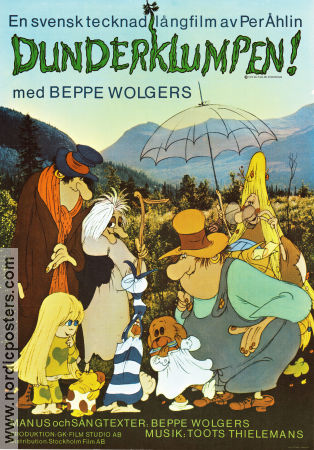
Dunderklumpen!

Jeg så igjen Dunderklumpen! i går kveld, og så moro er det lenge siden jeg har hatt det. Eller: så fint og barndomstrygt og -magisk er det lenge siden jeg har hatt det :-)

Filmen så jeg en gang da jeg var rundt 7 år, sammen med en venninne som hadde fått hjernerystelse og måtte holde seg våken. Siden da har jeg ikke sett filmen, men boka har jeg lest mange ganger som barn og også seinere.
Det er noe med svenske barnebøker og filmer som går rett inn hos meg nå og også gjorde det som barn. Handlingen i denne filmen er på midtsommernatta, og stemingen er intet mindre enn magisk - ikke bare gjør Dunderklumpen lekene levende, men den lyse natta og det velkjente norsksvenske landskapet med gran- og furuåser og fosser og kjemper og morgendis over vannene er perfekt setting for midtsommernattsmagi. Og så er det noe med 70-åra (som jeg ikke har opplevd) som virker så jordnært og fantastisk på en gang.

Filmen er fra 1974 og har god musikk (Toots Thielemans), levende og sjelfylte tegninger og ikke minst stemmer - Gösta Ekman og Hasse Alfredsson er to av de som gir stemmer til karakterene.

Heldig for meg at biblioteket hadde denne stående i hylla, ellers ville jeg aldri fått sett den på nytt. Kommer nok til å skaffe denne om jeg får barn noen gang! Mulig jeg er på vei til å bli gammeldags, men jeg liker godt de barnefilmene som ikke bare er action og skrik og skrål, men som har en rolig og morsom stemning. Og, ikke minst, magisk. Det er nøkkelordet på barndomskulturopplevelser som sitter spikret.

Sunday, March 08, 2009

Hommage to the maker of a cover


As the title of this post hints, this is written just to honour the designer of the cover of the first compilation of Emily Dickinson's poems in Norwegian translation. It looks even better in real life, as the branches are glossed in shining black and slightly elevated on the cover. The book both looks and smells of cherry blossoms.
There is to be another volume before the translation is complete.
The translator, Kurt Narvesen (who is also a poet) told me a long time ago that he was working on translating Dickinson's poetry. I was thrilled but not quite sure whether he was really telling the truth. As he had just finished translating Walt Whitman's Leaves of Grass, though, I hoped he was indeed telling the truth.
And so he was.
The result can now be viewed - and read! - if you visit a well-assorted book store. May I suggest Norli? Just follow this link, and you're on your way.
I heard the first spring birds singing today in the late March snow. It left me in a strange mixture of melancholy and optimism for what's to come this year.

Thursday, March 05, 2009

Jack Gilbert: Say you love me

Har du også hatt opplevelsen av å sitte inne i en glassboks, mens den du er sammen med sitter i en annen, med en helt annen farge på veggene enn dine? Eller at dine linser er konkave, mens den andres er konvekse? Noen ganger lurer jeg på om mannen min og jeg lever i samme virkelighet, eller om kommunikasjonen mellom øye og sinn går i rette, blanke skinneganger hos ham, og i krøllete, mangefargede ulltrådmønstre hos meg. Noe liknende har visst Jack Gilbert også erfart.


SAY YOU LOVE ME

Are the angels of her bed the angels
who come near me alone in mine?
Are the green trees in her window
the color I see in ripe plums?
If she always sees backward
and upside down without knowing it
what chance do we have? I am haunted
by the feeling that she is saying
melting lords of death, avalanches,
rivers and moments of passing through.
And I am replying, "Yes, yes.
Shoes and pudding."


Fra Refusing Heaven, 2005

Thursday, January 08, 2009

"I would not have been a poet, except..."


Long time no write, but by a strange coincidence, Wendell Berry once again ignited my desire for sharing through blogwriting. Berry is a poet I didn't know until I received a poem by him from a friend. This poem flowed in my direction from the same source, and how grateful am I.
I have not read any essays or stories by him, but I imagine his poetic vein infuses his words with lyric qualitites whatever genre he writes in. That is just the way with artists of language.
I find it particularly moving and true the way he honours silence and the huge world of wordlessness by circling his way around these truths through words. How else can we communicate truths to each other if not through some kind of language that we share? That is one of the beauties as well as shortcomings of language and being a human.
But, as we know, communicare necesse est. And what gems do not exist because of our need of communication? It is a most important web which ties us together.


VII

by Wendell Berry

I would not have been a poet
except that I have been in love
alive in this mortal world,
or an essayist except that I
have been bewildered and afraid,
or a storyteller had I not heard
stories passing to me through the air,
or a writer at all except
I have been wakeful at night
and words have come to me
out of their deep caves
needing to be remembered.
But on the days I am lucky
or blessed, I am silent.
I go into the one body
that two make in making marriage
that for all our trying, all
our deaf-and-dumb of speech,
has no tongue. Or I give myself
to gravity, light, and air
and am carried back
to solitary work in fields
and woods, where my hands
rest upon a world unnamed,
complete, unanswerable, and final
as our daily bread and meat.
The way of love leads all ways
to life beyond words, silent
and secret. To serve that triumph
I have done all the rest.


from A Timbered Choir: The Sabbath Poems 1979–1997

Tuesday, November 11, 2008

Wendell Berry: "How to be a poet (to remind myself)"

Stillness speaking.

***
How To Be a Poet

by Wendell Berry

(to remind myself)

Make a place to sit down.
Sit down. Be quiet.
You must depend upon
affection, reading, knowledge,
skill—more of each
than you have—inspiration,
work, growing older, patience,
for patience joins time
to eternity. Any readers
who like your work,
doubt their judgment.

Breathe with unconditional breath
the unconditioned air.
Shun electric wire.
Communicate slowly. Live
a three-dimensioned life;
stay away from screens.
Stay away from anything
that obscures the place it is in.
There are no unsacred places;
there are only sacred places
and desecrated places.

Accept what comes from silence.
Make the best you can of it.
Of the little words that come
out of the silence, like prayers
prayed back to the one who prays,
make a poem that does not disturb
the silence from which it came.


from Given, 2005


Wednesday, November 05, 2008

A propos Nov 4th

Yes, I am excited about the outcome of the election yesterday. Although it is unclear to me what exactly Obama's change means, his willingness to change and to be a flexible, unifying president rather than an antagonising leader working solely in a landscape of black-and-white and sharp contrasts without being able or willing to see nuances in the complex reality we live in, makes me hopeful.

"The new dawn of American leadership is at hand"? I certainly hope so.

Underneath are two statements from the candidates for presidency reaching outside the area of politics.

***

"There are greater pursuits than self-seeking. Glory is not a conceit. It is not a prize for being the most clever, the strongest, or the boldest. Glory belongs to the act of being constant to something greater than yourself." - John McCain


"I reject a politics that is based solely on racial identity, gender identity, sexual orientation, or victimhood generally. I think much of what ails the inner city involves a breakdown in culture that will not be cured by money alone, and that our values and spiritual life matter at least as much as our GDP." - Barack Obama

***

Friday, October 31, 2008

The Pocket-friendly Emily Dickinson


This is a handsome little book I bought about a year ago at Norli in Oslo, Norway. It is about 10X15 cm, and fits nicely in my handbag. I literally carry it with me wherever I go.

During train rides, or when sitting at my desk reading and writing notes and dissertations, I often pick this volume up for a break from what I am doing and for some creative input.

You can open this book on any page; originality and depth and striking metaphors will hit your eye in each poem here selected. Most of these poems are from around 1862 when Dicinson was in her most productive and literary interesting period.

Sometimes you just need a bit of comfort, or a sense of kinship, or you simply wish to be astonished by someone's imagination and perceptability, depth of insight and originality of thought.

Yesterday this poem was a gift of comfort to me. No need to say anything about the poem, it speaks for itself.

***

There is a pain — so utter —
It swallows substance up —
Then covers the Abyss with Trance —
So Memory can step
Around — across — upon it —
As one within a Swoon —
Goes safely — where an open eye —
Would drop Him — Bone by Bone.

***

Ca 1862

Sunday, October 26, 2008

Olav H. Hauge: "Your Way"


After having spent many days listening to the audiorecording of the Norwegian biography on Olav H. Hauge (Mitt liv var draum, K. O. Åmås), I find my mind to be more finely tuned into his language and poetry. His strongly marked dialect, which differs in many ways from my own more general and common form of language, in a way carries a specific personality. It's like his language becomes a poetic effect on its own.

The following is another famous poem here in Norway, and in its simplicity it points to something central to each of our particular expressions of existence. A comforting as well as uplifting poem. At least it is to me.


Your Way

No-one has marked out the road
you are to take
out in the unknown
out in the blue.

This is your road.
Only you
will take it. And there's no
turning back.

And you haven't marked your road
either.
And the wind smooths out your tracks
on desolate hills.

***

Translated by Robin Fulton

Wednesday, October 22, 2008

Children's art on environmental problems


I'm just adding this picture to my blog as I think it is so expressive. It is the winner of the first prize in UN's competition for children in portraying some of our planet's environmental challenges.


The picture is painted by a 13 year old girl (!), namely Charlotte Sullivan from England.

Tuesday, October 21, 2008

Gunvor Hofmo: Central female Norwegian poet


Gunvor Hofmo (1921-1995) is a central poet in Norway's literary landscape. The story of her life is closely connected to the poetry she wrote.
The second world war came to have a significant and lasting effect on her. Her first collection of poems to be published is from 1946 and was called Jeg vil hjem til menneskene, meaning I want to go home to the humans. With this she carved out a sense of meaninglessness and despair many people felt after that most inhuman war.
Part of Hofmo's personal despair during WW2 was that her particular friend, the Jewish Ruth Maier, was deported to Auschwitz where she died not long after. Their friendship was very close, and many have speculated whether they were lovers, although there is no real proof that they were more than friends. Later in life she lived with another woman writer, Astrid Tollefsen.
Maier's deportation may have been a major reason for why Hofmo was hospitalized with mental illness in 1943, with many more years of hospitalization before her. Ruth Maier's death was perhaps the most central event in Hofmo's life. Maier's absence seems to be an emptiness Hofmo keeps circulating around throughout her life, much of it recorded in her writings. From 1955 to 1971 Hofmo stayed at Norway's major mental hospital, and she did not publish anything during those years. But from 1971 she moved into a flat of her own and she again started publishing, continuing this until her death in 1995.
The following poem is one of great simplicity and at the same time great clarity and quiet. It is from a collection bearing the same name as the poem, published in 1991.


Navnløst er alt i natten

Navnløst er alt i natten
Stille, time etter time
legger tingene sine
navn fra seg
Treet og stenen
tolker altets stemme
og mister sin egen
identitet.


***
At nighttime everything is nameless

At nighttime everything is nameless
Quietly, hour by hour
the things leave their
names behind
The tree and the rock
interpret the voice of the absolute
and lose their own
identity.
***

In somewhat the same vein is this poem from 1973:


Ingen klage

Ingen klage. Ingenting
Som glasset langsomt
fylles med kostbar vin

fylles vår dag
av naken eksistens.


***

No complaint

No complaint. Nothing at all
Like the glass is slowly
filled with precious wine

our day is filled
with bare existence.

***